
How to Read Casino Terms & Conditions: What Players Should Check First

Three sections of a casino’s terms and conditions decide whether you actually get paid. Wagering requirements, withdrawal rules, and prohibited activities are what matter. Everything else in an 8,000-word T&C document is mostly boilerplate. I learned this the slow way, after a $50 bonus turned into a three-week email chain over a game contribution rule I never read. Read those three sections before you deposit. Skim the rest if you want. Wagering multipliers, withdrawal windows, game contribution rates, bonus abuse flags, restricted territories, currency conversion fees, and progressive jackpot terms are the eight clauses most likely to affect whether you actually get paid.
Bonus Terms and Wagering Requirements
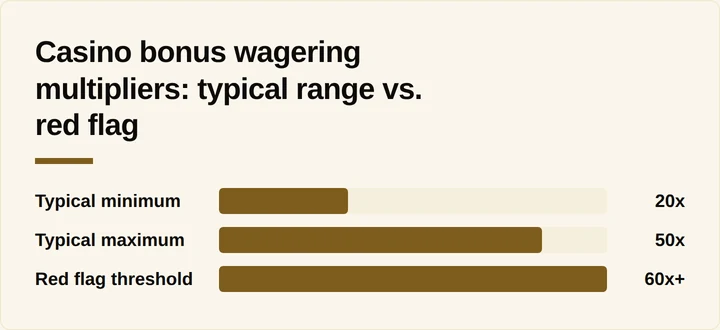
Wagering requirements are the single most disputed clause in any casino bonus. They set how many times you need to bet the bonus amount before you can withdraw anything tied to it, and the multiplier usually falls between 20x and 50x. A $100 bonus at 35x wagering means placing $3,500 in total bets before those winnings become yours to cash out. That number sounds abstract until you sit down and calculate how many spins it actually takes at a $1-2 bet size.
Three details matter more than the headline multiplier. They are maximum bet limits, game contribution rates, and time windows.
- Maximum bet limits. Most operators cap individual bets during bonus play at $5-8. Go over that limit even once and the operator can void the entire bonus, including any winnings already accrued.
- Game contribution rates. Slots count 100% toward wagering requirements. Table games like blackjack or roulette contribute only 10-20%. Some games are excluded entirely. I learned this when my blackjack play failed to satisfy my bonus wagering—that was how I lost my $50 bonus.
- Time limits. Bonuses usually expire in 7-30 days. Miss the window and the unused portion, plus any linked winnings, gets forfeited automatically.
Players who take time to understand bonus mechanics before accepting a promotion are more likely to complete the requirements successfully. Support agents see this pattern firsthand. Most disputes over “missing” bonus winnings trace back to a game contribution rule nobody checked first.
Withdrawal Policies and Verification
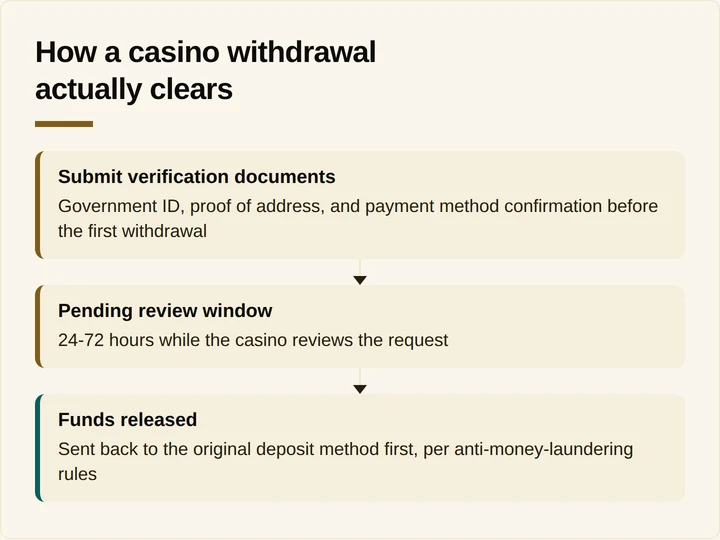
Withdrawal terms decide how fast you actually see your money. Look for three numbers. The pending period, the verification requirements, and the withdrawal limits are what matter. These reveal which operators are trustworthy.
Pending periods run 24-72 hours in most cases, a window during which the casino reviews the request and you can technically reverse it back into your account balance. Verification, sometimes called KYC, means submitting a government ID, proof of address, and confirmation of your payment method before a first withdrawal clears. I’ve had this take under a day at one operator and closer to three at another running the same document set through a slower back office. Ask support what you’ll need to provide before you deposit. Don’t wait until you’re cashing out.
| Aspect | Typical Requirements | Red Flags |
| Verification | ID, proof of address, payment method proof | Requests for excessive or repeated documentation |
| Processing Time | 1-5 business days | Delays running well past the stated window with no explanation |
| Minimum Withdrawal | $10-50 | Minimums set above $100 |
| Maximum Withdrawal | $5,000-10,000 per transaction | Caps low enough to force dozens of separate withdrawals |
| Monthly Limit | $10,000-50,000 for standard accounts | No stated monthly cap disclosed anywhere in the terms |
If a term sheet lists a maximum withdrawal so low that a modest win takes months to fully cash out, flag it as a serious red flag. Legitimate operators disclose monthly caps clearly; the ones worth avoiding tend to bury that number or leave it out.
Account Restrictions and Prohibited Activities
Every casino’s terms include a list of behaviors that can get an account suspended or closed outright, and multiple-account creation sits at the top of nearly every one. Detection systems cross-reference IP addresses, device fingerprints, and payment methods, so a “fresh start” account rarely goes unnoticed. If you share a household with a family member who also plays, check the specific wording on multiple accounts per address before either of you sign up. Some operators explicitly permit it with separate verification; most don’t.
Bonus abuse is the second common trigger, covering strategies designed to extract promotional value without genuine play, like minimum-bet wagering on excluded games or coordinated account activity. Operators that spell out bonus abuse rules in plain language, with examples, tend to have clearer dispute records than those relying on vague legal wording.
Restricted-territory clauses are worth a second look too. Accessing an account through a VPN from a jurisdiction where the operator doesn’t hold a license is treated as a terms violation. The consequence is severe. The operator closes the account and confiscates all funds.
Payment Method Terms and Fees
Payment terms govern which deposit methods you can use, what fees apply, and how withdrawals get processed. Withdrawals must route back through the deposit method you used—an anti-money-laundering requirement, standard across licensed operators. This catches players off guard. Deposit with a card and you’ll withdraw to that card first before other methods become available.
Currency conversion is the other fee worth checking before you fund an account. If your card or e-wallet operates in a currency different from the casino’s base currency, conversion fees typically run 2-5% of the transaction. On a $200 deposit that’s $4-10 disappearing before a single spin. Third-party payment restrictions apply too. Deposits from a card or account not registered in your own name are grounds for a hold or reversal, and chargebacks on a casino account almost always trigger an immediate suspension pending investigation.
Game Rules and RTP Disclosure
Game-specific terms outline payout structures and return-to-player percentages, the long-run share of wagered money a game pays back. Slots commonly disclose RTP in the 94-97% range, though the exact figure varies by title and sometimes by jurisdiction version of the same game. Progressive jackpot terms deserve a close read on their own. Many require a maximum bet to qualify for the jackpot tier, meaning a player betting below that threshold could hit the jackpot symbol combination and still not receive the jackpot payout.
Malfunction clauses deserve attention before you play. These clauses void pays and plays in the event of a technical error, which is a reasonable protection against genuine software bugs. The problem is that the same clause sometimes gets invoked when an operator disputes a legitimate win it doesn’t want to honor. Screenshot any significant win the moment it happens, including the balance and game screen together, so there’s a timestamped record if the payout is ever contested.
Responsible Gambling and Self-Exclusion
The tools available to control play are deposit limits, loss limits, session time limits, and self-exclusion. Increasing a limit typically requires a 24-72 hour cooling-off period before it takes effect, a deliberate friction point designed to stop an in-the-moment decision from overriding a calmer one. Decreasing a limit takes effect immediately, since there’s no harm-reduction reason to delay it.
Self-exclusion periods range from six months to permanent closure, and during that window a compliant operator has to block account access and reject any new account attempt tied to your identity, not only the original login. In Ontario, licensed operators fall under iGaming Ontario and AGCO oversight. Self-exclusion tools are mandatory. They’re built into licensing requirements. If you’re setting a deposit limit for the first time, set it lower than what feels comfortable. It’s far easier to raise a limit later than to claw back a deposit you already made. Gambling should stay entertainment, never a way to solve financial problems. Only adults 18 or older can play (19+ in most Canadian provinces). If play stops feeling fun, Ontario’s ConnexOntario line and each operator’s self-exclusion tools exist for exactly that moment.
Dispute Resolution Procedures
Every T&C document includes a process for resolving conflicts. Read it proactively, not when you’re already in a dispute. Most start with a support ticket or live chat, escalating to a manager if the front-line agent can’t resolve it. The terms should also name an independent dispute resolution service, an alternative dispute resolution (ADR) body separate from the operator, for cases where internal escalation stalls out.
Time limits for filing a complaint typically run 30 to 90 days from the disputed event, and letting that window close forfeits your right to escalate further. Document everything as it happens. Save screenshots, chat transcripts, and timestamps. A dispute filed on day 85 with no supporting record is a much weaker case than one filed on day 3 with a saved chat log attached.
Identifying Unfair Terms
A handful of clauses signal an operator worth walking away from before you deposit at all:
- Playthrough requirements above 60x the bonus value. At that multiplier, completing the wagering is close to mathematically impossible for a recreational player’s bankroll.
- Maximum cashout caps of 2-5x the bonus amount. A $50 bonus capped at 3x cashout means the most you’ll ever see from it is $150, regardless of how well you actually play.
- Hidden fees: monthly account maintenance charges, currency conversion markups well above the 2-5% norm, or withdrawal fees that aren’t disclosed until the request is already in progress.
- Unexplained delays stretching past the operator’s own stated processing window, with support unable to give a reason on request.
None of these clauses are automatically illegal, and most licensed operators disclose them somewhere in the terms. The issue is transparency. A term buried in section 14.3 with no plain-language summary creates confusion. One flagged clearly at signup does not, even when the underlying rule is identical.
FAQ
What are the most important sections of casino terms and conditions?
Wagering requirements (multiplier, max bet limits, game contribution rates, time limits), withdrawal policies (verification steps, processing times, minimum and maximum limits), and prohibited activities (multiple accounts, bonus abuse, restricted territories) cover the clauses most likely to affect whether you actually get paid.
How long do I have to complete bonus wagering requirements?
Most operators set a completion window of one to four weeks, with larger bonuses sometimes allowing more time and smaller promotional offers requiring completion within seven days. Check the exact figure in the specific bonus terms, since it varies by promotion and operator.
Can casinos change their terms and conditions without notice?
Licensed operators can update terms but generally have to give advance notice, often about a month, so players can review changes before they apply. Applying new terms retroactively to funds or bets already placed is not standard practice among regulated operators and is worth flagging to a regulator if it happens.
What should I do if I don’t understand a specific clause?
Contact support and ask before you deposit or opt into a bonus, not after. Request the answer in writing, through email or a saved chat transcript, so there’s a record if the clause becomes relevant later. If the explanation is still unclear or keeps changing, that’s a signal to look at a different operator.
Do wagering requirements apply to deposited funds or just bonus money?
It depends on the bonus type. Some promotions wager only the bonus amount. Others wager the deposit and bonus combined, which roughly doubles the total betting requirement. Check the first paragraph of the bonus terms for this distinction. Confirming upfront is smarter than assuming.
Why did my withdrawal get delayed past the stated processing time?
Common causes include incomplete verification documents, a mismatch between the deposit and withdrawal method, or a manual review triggered by an unusually large win. Contact support directly for the specific reason. A delay accompanied by a clear explanation is manageable. A delay with no communication is troubling.
Is it normal for a casino to ask for ID before my first withdrawal?
Yes. Identity verification before a first payout is standard practice across licensed operators. It’s required for anti-money-laundering compliance. What’s worth questioning is a request for documentation well beyond a government ID, proof of address, and payment method confirmation.
Where can I get help if gambling stops feeling like entertainment?
In Ontario, ConnexOntario (1-866-531-2600) provides free, confidential support, and every licensed operator’s terms include a self-exclusion tool that can be activated directly through account settings or by contacting support. These tools exist for exactly this situation. Using them means the terms are working the way they should.