
How Affiliate Disclosure Rules Actually Work for Gambling Content Sites

A gambling content site operating for Ontario readers can publish affiliate links without holding its own AGCO licence. It still has to link only to operators on the public AGCO register and never publish a bonus ad that skips the mandatory disclosure elements. Disclosing the commercial relationship clearly is standard industry practice. No written AGCO duty forces it on affiliates directly. Doing it anyway is what keeps an operator willing to work with you. Most of the compliance weight sits on the operator paying for the traffic. An affiliate site still has to follow the rules that do apply to it; they just work through a different mechanism than most people assume.
That distinction confuses a lot of people who write about online casinos.
Who’s actually on the hook here
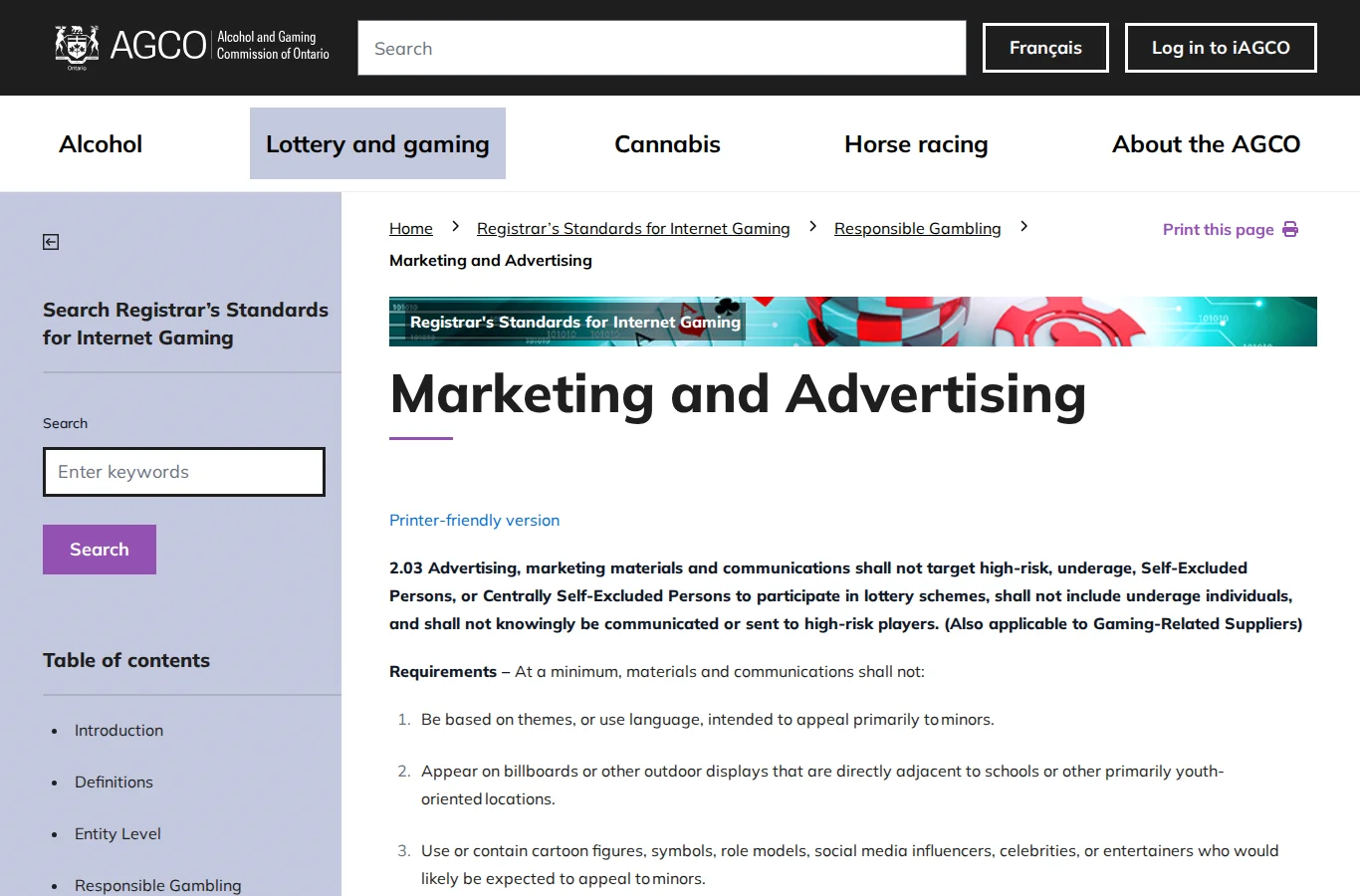
The AGCO’s Registrar’s Standards put the compliance burden squarely on the operator. Ontario’s regulator makes it explicit. An operator has to ensure any third-party marketing affiliate meets the same advertising standards the operator itself has to follow. There’s no separate affiliate licence in this province. You can run a casino content site all day without ever filing paperwork with the AGCO.
That sounds like good news for affiliates, and in one sense it is. It also shifts the incentive structure. Because the operator carries the regulatory risk, it’s reasonable to expect a serious operator to check an affiliate site before paying out commissions. That includes what you’ve written, how you’ve disclosed the relationship, and whether your bonus copy matches what’s actually permitted. An operator that gets flagged for an affiliate’s bad ad loses more than that affiliate’s traffic. It risks a standards violation on its own licence.
I’ve gone through this from the other side, checking our own affiliate-disclosure page against what an operator’s compliance team would actually look for before approving a link, the same way we verify any claim under our fact-checking policy. They aren’t reading for tone. They’re reading for whether the material terms are visible before someone clicks, and whether the operator is one that’s actually registered.
This is the part people miss. Rules still apply to affiliates even without a licence requirement, and the operator’s own contract is what enforces them. Lose an operator’s trust and you lose the commercial relationship. Keep publishing content that puts an operator at risk, and eventually you run out of operators willing to work with you.

The three standards that actually govern your bonus content
Three AGCO standards do almost all the practical work for a content site. None of them are long, and none of them require a law degree to apply once you’ve read them once.
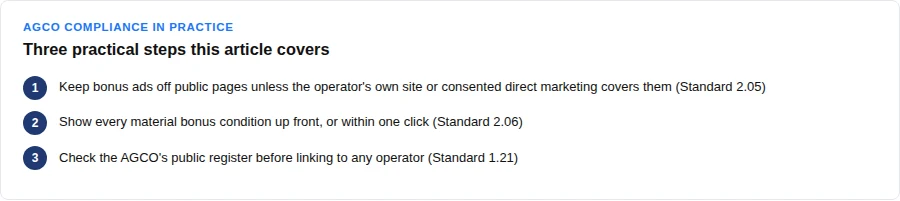
Standard 2.05 bans advertising that communicates gambling inducements, bonuses or credits anywhere except on the operator’s own gaming site, or through direct marketing where the player has already given active consent. That’s a narrower gate than a lot of affiliates assume. A public bonus ad on a content page, or an algorithm-targeted bonus banner, is exactly the kind of placement this standard prohibits.
Standard 2.06 applies where inducement terms are permitted at all. Every material condition and limitation has to be disclosed at first presentation, and anything left unstated can be no more than one click away. I tested this on a handful of operator bonus pages by clicking through their own terms links to see whether the wagering requirement showed up on the landing page or only after a second click. Most did it in one click. A couple buried it further, which is exactly the failure mode this standard exists to catch.
The same standard bans calling an offer “free” or “risk-free” unless that’s literally, contractually true. Not “mostly true.” Not “true if you read the fine print the right way.” Literally true.
Standard 1.21 matters most for a link-heavy content site. When a link promotes an operator that isn’t on the AGCO’s public register, that operator is the one in violation, full stop, regardless of what the commercial deal behind the link looks like. Because that operator’s own violation traces back to the affiliate that ran the link, the register check moves from generic advice to an actual compliance step. Ignorance of an operator’s registration status doesn’t protect the operator, and it doesn’t make an affiliate a safe partner to keep working with.
Every permitted bonus ad also needs three fixed elements. Those are the iGaming Ontario logo, a responsible-gambling message, and a geo-restriction disclaimer. Miss any one of the three and the ad doesn’t meet the standard, no matter how accurate the bonus terms themselves are.
| Standard | What it covers | Practical trigger for an affiliate site |
|---|---|---|
| 2.05 | Where bonus/inducement ads can appear | Don’t run public or targeted bonus ads off the operator’s own site or unconsented direct marketing |
| 2.06 | Disclosure of material terms | Show conditions up front, or one click away; never call something “free” unless it is |
| 1.21 | Operator must be on the AGCO register | Check the register before linking, every time |
What changed on January 1, 2026, and why it raises the stakes
The Canadian Gaming Association published a Code for Responsible Gaming Advertising in October 2025, administered by Ad Standards Canada. Since that date, Ad Standards has been accepting public complaints about specific ads and content, alongside the AGCO’s own enforcement.
One piece of non-compliant content can now trigger two separate processes at once. A reader who spots a bonus ad missing the responsible-gambling message can file a complaint with Ad Standards. The same ad can independently draw an AGCO inquiry through the operator’s standard compliance obligations. Until Ad Standards started taking complaints, the AGCO route was effectively the only formal path. Two separate channels can now open a case over the same ad.
These core standards haven’t moved, so what “compliant content” looks like hasn’t changed in principle. What’s changed is who can flag a problem, and how fast. A single complaint from a member of the public didn’t used to have anywhere obvious to go outside AGCO’s own monitoring. Now it does.
For a content site, the practical effect is that sloppy bonus copy carries a second layer of exposure it didn’t carry a year ago. It’s still the operator’s regulatory neck on the line. But an operator watching two enforcement channels instead of one is going to be less patient with affiliate sites that cut corners.
Blanket disclosure versus the FTC’s four-factor test
There isn’t one universal way to disclose a commercial relationship.
The US FTC’s Endorsement Guides, found at 16 CFR Part 255, set the widely-cited baseline for what “clear and conspicuous” disclosure means mechanically. For an Ontario-focused site it functions as the industry’s common reference point, worth understanding on its own terms. The FTC test judges disclosure on four factors:
- Proximity: is the disclosure physically close to the claim it qualifies?
- Prominence: is it sized and contrasted so it’s actually noticeable?
- Plain language: does it avoid jargon a reader has to decode?
- Placement: is it visible before the reader acts, ahead of any click-through?
That’s a per-link, per-moment standard. Every commercial link, in theory, gets its own disclosure right there next to it.
Our own affiliate-disclosure page (/affiliate-disclosure/) works differently. It uses a blanket model. It tells readers upfront that any operator we link to may be a commercial relationship, and doesn’t tag each individual link as it appears. It also states that we check terms against an operator’s own published pages the same way whether the link is commercial or not, which matters because it means the disclosure model doesn’t change what gets verified.
The trade-off is real. A blanket disclosure is simpler to maintain on a smaller site and genuinely hard to miss if it sits somewhere a reader is likely to see. It puts the disclosure upfront during browsing. The FTC’s proximity factor calls for disclosure right beside each individual link. Both models work. One builds a global statement of relationship, the other delivers a moment-by-moment reminder at each link.
None of this substitutes for the AGCO standards above. The FTC framework is a useful mechanical yardstick for what “readers actually notice and understand a disclosure” looks like in practice. The AGCO standards remain the law that applies here.
What this actually means if you’re running a gambling content site
- Check the AGCO’s public register before you link to any operator. Standard 1.21 doesn’t care about your commercial arrangement if the operator isn’t listed, the same registration detail we track on our own licensing page.
- Keep bonus copy off public pages unless you’re certain the placement fits the narrow exceptions for promotional content, and disclose material terms up front if you do run any inducement content.
- Pick a disclosure model, blanket or per-link, and be consistent about it. What matters more than which model you choose is whether a reader can actually find and understand it.
None of this is about tone or getting caught being clever with wording. It’s about whether the terms you’re describing match what’s actually offered, and whether the operator you’re pointing to is one the AGCO recognizes at all.
None of this is a substitute for basic safer-play awareness, and that point matters regardless of which disclosure model a site uses. This content is for readers 18 and over. If gambling content is something you read regularly, it’s worth knowing where the tools are if you or someone you know needs them. We keep that separate from the disclosure conversation deliberately, on /safer-play/, because they’re different problems even if they show up on the same pages.
FAQ
Do gambling affiliates need their own AGCO licence in Ontario?
No. There’s no affiliate-specific registration in Ontario. The compliance obligation sits with the operator, who has to ensure its marketing affiliates meet the same standards it does.
Can an affiliate site publish a public bonus ad for a casino?
Generally no. The inducement standard restricts inducement advertising to the operator’s own gaming site, or to direct marketing where the player has given active consent. Public and algorithm-targeted bonus ads fall outside that. On the rare permitted ad, the iGaming Ontario logo, a responsible-gambling message and a geo-restriction disclaimer all have to appear.
What has to be disclosed if a bonus offer is shown at all?
Under the disclosure standard, all material conditions and limitations need to be disclosed at first presentation, with anything left over no more than one click away. “Free” or “risk-free” can only be used if it’s literally true.
What happens if I link to an operator that isn’t on the AGCO register?
That’s a violation of the registration requirement regardless of the commercial arrangement behind the link. Checking the register before publishing a link is the practical way to avoid this.
What changed with Ad Standards Canada on January 1, 2026?
Ad Standards Canada started accepting public complaints about specific gambling ads or content that day, under a Code published by the Canadian Gaming Association in October 2025. That runs alongside AGCO’s own enforcement, so a single non-compliant piece of content can now draw scrutiny from both.
Is a blanket affiliate disclosure statement enough, or do I need to disclose next to every link?
Both approaches exist. A blanket disclosure, stating that any linked operator may be a commercial relationship, is simpler to maintain and hard to miss on a small site. The FTC’s four-factor test prefers disclosure right next to each individual claim. Whichever model a site picks, it should actually be visible and understandable to a reader.
Does the FTC’s Endorsement Guide apply to an Ontario gambling content site?
It doesn’t apply as operative law here. It’s a US framework, useful as a mechanical reference for what “clear and conspicuous” looks like; the rules that actually govern this content are AGCO’s Registrar’s Standards.
Who checks whether my content complies, if I don’t have a licence to lose?
Operators do, because their own registration is at risk if an affiliate’s content violates the standards. That’s why you should expect a serious operator to check an affiliate site before paying commissions and continuing the relationship.