
Bankroll Management Tips for Online Casino Players

Bankroll management is the practice of setting a fixed gambling budget, sizing your bets against it, and walking away at predetermined win or loss points. Decisions stick to the plan regardless of impulse or how the session feels in the moment. The house edge stays the same regardless of your bet size or strategy. What changes is whether a night at the tables stays entertainment or crosses into a spending problem. This article explores how to set that budget, size your bets sensibly, and use the limit tools Canadian regulators already put in front of you. This is general guidance for adults 18+ (or the legal gambling age in your province) and should be paired with professional advice if gambling starts to feel out of your control.
How I Set My Gaming Budget Before I Ever Log In
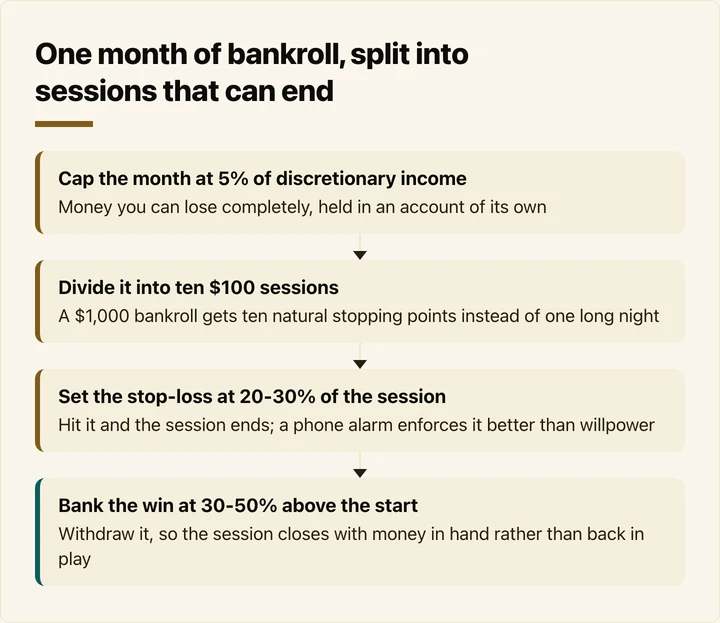
The budget comes first, before any game selection or bonus hunting. It has to be money you can afford to lose completely. This means setting it aside from rent, emergency savings, and credit lines. A common starting point is capping monthly gambling spend at around 5% of discretionary income, the money left over after bills, savings, and debt payments are handled.
I keep gambling funds in a separate account from my everyday spending. It sounds like overkill until the first time you’re two drinks in on a Friday and your regular debit card is sitting right there in your wallet. A dedicated account, or a prepaid card loaded once a month, removes that decision entirely. There’s simply nothing extra to spend.
Budget ground rules that hold up over time:
- Never fund gambling with borrowed money or credit
- Set the monthly amount once and leave it alone, win or lose
- Keep gambling funds walled off from savings or investment accounts
- Revisit the number every few months as your finances change; avoid adjusting it during an active session
Time matters as much as money. Sessions that run past two hours tend to drift, with decisions getting looser and the total spend becoming hard to track. A budget without a time boundary is only half a plan.
The 1-5% Rule I Use for Bet Sizing
Once the budget is set, bet size decides how long it lasts. The common guideline is to keep individual bets between 1% and 5% of the total bankroll, adjusted for how volatile the game is. Low-variance games can sit at the higher end of that range; high-variance ones need smaller bets to survive the swings.
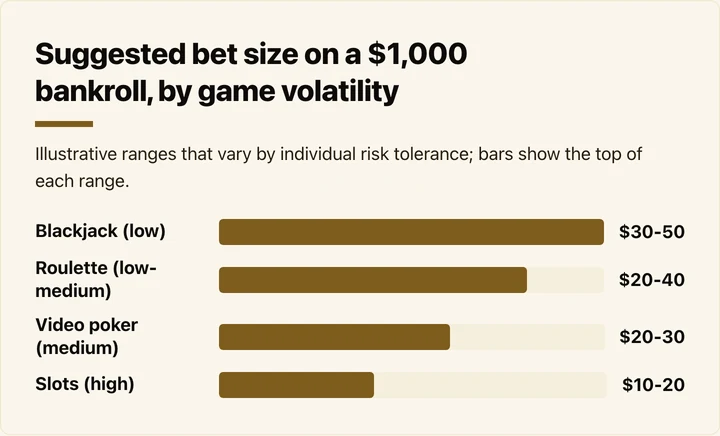
On a $1,000 bankroll, that works out to roughly $10-50 per bet depending on what’s being played. I learned this the hard way on a slot session where I was betting closer to 8% a spin. The bankroll was gone in fifteen minutes, well before the game’s own variance had a chance to even out.
General bet-sizing guidance by game type (illustrative ranges that vary by individual risk tolerance):
| Game Type | Typical Volatility | Suggested Bet Size | Example on $1,000 |
| Blackjack | Low | 3-5% | $30-50 |
| Roulette | Low-Medium | 2-4% | $20-40 |
| Video Poker | Medium | 2-3% | $20-30 |
| Slots | High | 1-2% | $10-20 |
These are starting points designed for typical conditions. Your own risk tolerance and the specific game’s pay table should guide your final choice.
Win and Loss Limits That Actually Stick
A loss limit is a number you decide on before you sit down, and it’s the one rule that has to survive contact with a bad session. A common approach sets the stop-loss at 20-30% of the session bankroll. Hit it, and the session ends, no exceptions, no “one more spin to get it back.”
Win limits work the same way in reverse. Setting a target around 30-50% above your starting session amount gives you a clean point to walk away with something. I set a phone alarm for both numbers now, because relying on willpower alone at the exact moment a limit is hit is asking a lot of anyone.
The discipline part is the hard part. Most casino platforms have built-in limit tools that lock you out automatically once a threshold is reached. They’re worth using if the app or site offers them, since they don’t care how you feel in the moment.
Using Canada’s Player-Protection Tools
Beyond personal limits, Canadian players have regulator-backed tools to lean on. Knowing how these tools work before you need them makes them far more valuable in the moment. In British Columbia, BCLC’s GameSense program pairs self-exclusion with education and counselling referrals, and staffs GameSense Advisors at Info Centres inside BC casinos and gaming centres. BCLC also runs PlayPlanner, which lets players set time and spending limits directly on electronic gaming machines and PlayNow accounts.
Other provinces run their own versions. Alberta, Manitoba, Saskatchewan, and Québec each operate a self-exclusion programme through their provincial lottery or gaming authority. In Alberta specifically, AGLC’s programme covers casinos, racing entertainment centres, and Play Alberta accounts together, so one self-exclusion applies across all three. In Ontario, iGaming Ontario maintains a self-exclusion register that covers provincially regulated online casino sites.
Deposit limits, loss limits, and session limits are standard tools that regulated Canadian operators are required to offer, sitting on top of whatever budgeting you do yourself. These tools form part of the regulatory baseline. If you want the full province-by-province rundown, responsible gambling in Canada covers what’s available and how to set it up. Using one means you’re treating the limit the same way you’d treat a budget line item.

Why I Split My Bankroll Into Sessions
A monthly bankroll spent all at once in a single sitting defeats the point of having a monthly bankroll. Splitting it into session-sized chunks keeps any one bad night from wiping out the whole month. For example, a $1,000 bankroll divided into ten $100 sessions creates natural stopping points. Between sessions, that money needs to be genuinely out of reach. A payment method with a withdrawal delay, or moving unused funds to a separate account after each session, works by building friction into the system. Structural barriers outperform willpower-based approaches. This forced pause also lets you review how the last session went, preventing the pattern of rolling straight into the next one on autopilot.
Matching Games to What I Can Actually Afford
Game selection requires matching your bankroll to the stakes. Minimum bets, volatility, and how long a session realistically lasts all shift depending on how much you’re working with. Smaller bankrolls do better on games with flexible minimum bets and lower volatility, since there’s less room to absorb a rough stretch.
Rough bankroll-to-minimum-bet guidance:
- $1-5 minimum bet games pair reasonably with bankrolls under $500
- $5-10 minimum bet games generally need $200-400 to sustain a session
- $25 minimum tables call for something closer to $1,000-2,000
- High-limit tables ($100+ minimums) really need $5,000 or more to absorb normal variance
- Progressive jackpot slots with max-bet requirements need proportionally more, since the biggest prizes usually require the top wager
This guidance matches the game’s swings to what your bankroll can sustain. Even so, losing sessions are always possible.
How I Track Every Session
Record-keeping is the part almost everyone skips, and it’s the part that tells you the truth about your own play. I log starting bankroll, ending balance, game played, and time spent for every session; a basic spreadsheet does the job, though dedicated tracking apps exist too. The real value emerges when you step back and review all the data as a whole. Adding it all up once a month turns vague impressions (“I think I broke even”) into actual numbers, and lets you calculate something closer to a real entertainment cost per hour. The aggregated monthly total reveals the full picture far more clearly than any single session. It’s the clearest signal I’ve found for whether the budget itself needs adjusting.
Bankroll Mistakes I’ve Learned to Avoid
The martingale system involves doubling your bet after every loss to “guarantee” recovering it on a win. This is a mathematical trap and the mistake that comes up most often. Bet sizes escalate fast during a losing streak, and table limits or a shrinking bankroll eventually make the strategy impossible to continue, usually right when the losses are largest.
Chasing losses in general, whether through bigger bets or longer sessions than planned, accounts for most of the serious bankroll damage I’ve seen described by other players and in my own early sessions. Bonus chasing carries a quieter version of the same risk. Claiming a bonus without reading the wagering requirements can lock funds in place far longer than expected, converting what looked like a bonus into an unwanted bankroll constraint. Ignoring game variance is another quiet drain: treating a high-volatility slot the same way you’d treat a low-volatility table game leads to bet sizes that look fine on paper and drain a bankroll in a handful of spins. Skipping the pre-session budget review causes a similar problem, since the plan you set a month ago stops matching your actual finances if nothing gets checked along the way. Playing while tired or frustrated tends to widen every one of these mistakes at once, because the discipline that keeps bet sizing and session limits in place is exactly what fades first under stress. None of these habits require a big single moment to cause damage. They tend to compound quietly across several sessions before the total loss becomes obvious.
My Take on Bankroll Management
None of this changes the odds on any game; the house edge remains constant. Bankroll management gives you control over how gambling fits into your finances and your time. Your stopping point comes from the plan you set, not from whatever hand you’re dealt or the streak you’re in. A clear budget, sensible bet sizing, limits you actually enforce, and honest tracking make gambling a form of entertainment with a defined cost. If gambling stops feeling optional, that is the moment to activate the self-exclusion and support tools covered above.
FAQ
What percentage of my bankroll should I bet per game?
A common guideline keeps individual bets between 1% and 5% of total bankroll, adjusted for volatility. High-variance games like slots generally call for the lower end (1-2%), while lower-variance games like blackjack can sit closer to 3-5%.
How do I figure out what my gambling budget should be?
Start from disposable income (what remains after bills, debt payments, and savings) and cap gambling spend at a small, fixed share of that, often cited around 5%. The exact number matters less than picking it once and sticking to it regardless of results.
Should I withdraw winnings right away?
Many players withdraw a meaningful portion of any win that clears several times their session bankroll. Locking in winnings by cashing them out — keeping some off the table — is what transforms a win from a theoretical gain into actual money in hand.
What’s the easiest way to track gambling sessions?
A simple spreadsheet with session date, starting and ending bankroll, game played, and time spent covers the essentials. Dedicated tracking apps exist as alternatives. Reviewing the numbers every month is what makes the habit useful, whichever format holds them.
Do Canadian online casinos have to offer deposit or loss limits?
Regulated operators in Canadian provinces are generally required to provide limit-setting tools alongside self-exclusion options, and several provinces run their own programs through bodies like BCLC, AGLC, or iGaming Ontario.
Is the martingale betting system safe to use?
No. It requires an unlimited bankroll and no table limits to work as intended, and neither exists in practice. A losing streak long enough to break the system is entirely possible, and it tends to arrive right when bet sizes are already at their highest.
How often should I review my gambling budget?
Every few months is reasonable, or any time your income or expenses change significantly. Avoid reviewing your budget in the middle of a losing streak when frustration clouds judgment. Scheduled reviews produce better decisions than reactive ones made in the heat of a bad session.
What’s the difference between a loss limit and self-exclusion?
A loss limit caps how much you can lose in a session or time period and still lets you keep playing within that boundary. Self-exclusion blocks access to gambling accounts or venues entirely for a set period, and is a stronger step typically used when limits alone aren’t enough.