
How KYC Verification Actually Works Before Your First Payout

In short, before your first withdrawal, an Ontario casino has to hold an account whose identity details were validated at sign-up, and under federal anti-money-laundering rules it has to verify who you are before it pays anything out. FINTRAC’s guidance sets out three identity-verification methods. Ontario’s regulator does not mandate which one the operator uses, and neither rulebook sets a clock for how fast it happens.

Why does a casino ask for ID at all?
Because two separate rulebooks touch identity, and they answer two different questions.
The provincial one is about who is allowed to hold an account and gamble. The federal one is about money. The AGCO sets the terms for internet gaming in Ontario. FINTRAC, Canada’s financial intelligence unit, sets the anti-money-laundering terms that casinos fall under as reporting entities.
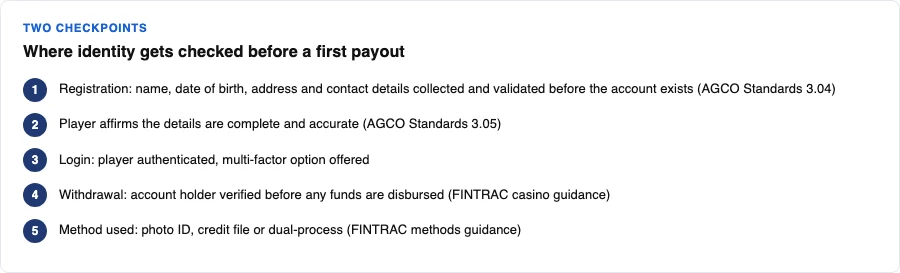
The AGCO Standards cover how the account is opened. The FINTRAC guidance covers when casinos must verify identity around transactions, including before funds are disbursed to an account holder. The rules fix two points, set out below.
Each operator also has its own procedures, and those differ from site to site.
Operators are required to keep an audit trail that covers identity verification results.
What do the rules actually say?
The AGCO Registrar’s Standards for Internet Gaming and the FINTRAC casino guidance are the primary texts here. Their wording matters more than the marketing copy on a casino’s help page.
The AGCO side
The Registrar’s Standards for Internet Gaming are explicit at registration. Section 3.04 requires the operator to collect a minimum set of information, namely name, date of birth, address, login identifier, contact information, and anything required under Canada’s anti-money-laundering law. That information “must be demonstrated complete, accurate and validated” before a player account is created.
Read that again. The check happens before the account exists, which is earlier than the first withdrawal. Section 3.05 adds that the player must affirm the information is complete and accurate before account creation.
The Standards also require players to be authenticated before accessing an account or gambling, require multi-factor authentication to be offered at login, and require re-verification of registered player information when prohibited or self-excluded lists change. And the age line is 19. Individuals under 19 are not eligible to play, with a narrow exception for 18-year-olds accessing a site solely to buy a lottery ticket.
Here is the sentence that does most of the work for this article. The Standards do not prescribe a specific identity-check method. The AGCO tells operators that identity must be validated. It does not tell them which document or database to use.
The FINTRAC side
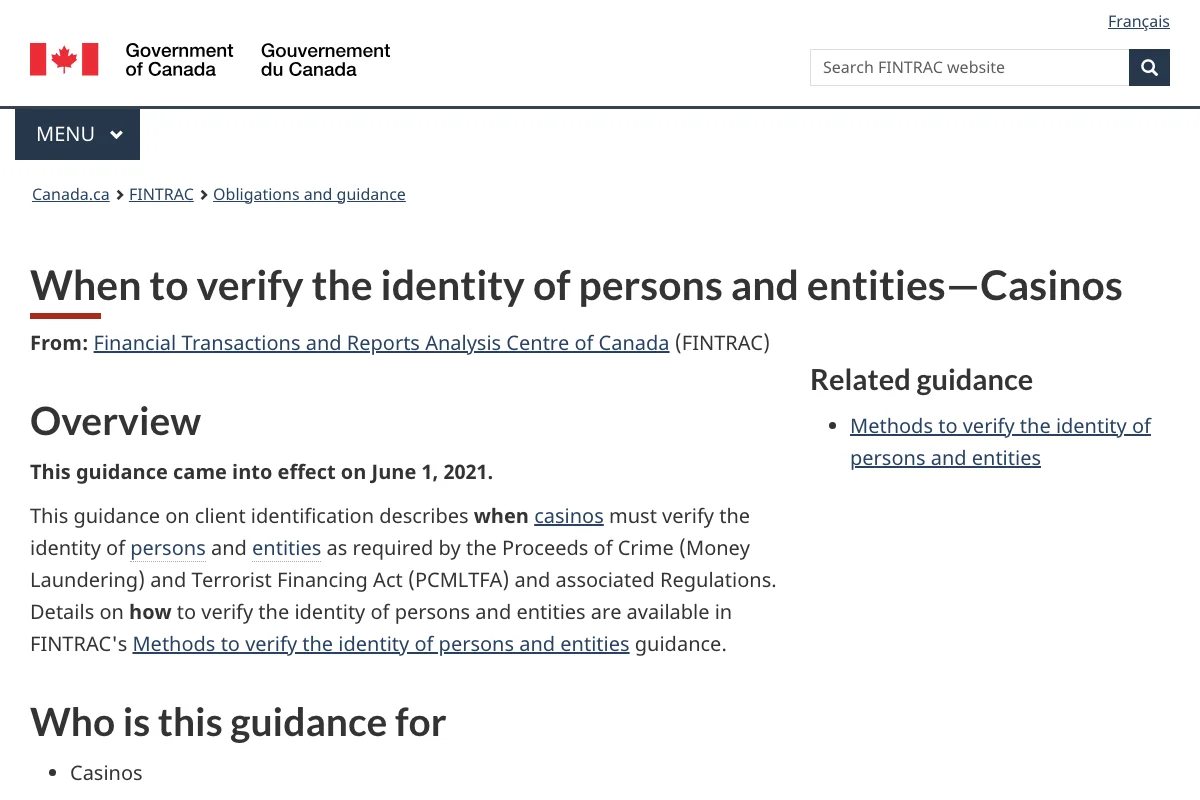
The FINTRAC casino guidance, effective 1 June 2021, lists the triggers. Casinos verify identity for these triggers.
- large cash transactions of $10,000 or more
- large virtual currency transactions equivalent to $10,000 or more
- suspicious transactions
- casino disbursements of $10,000 or more
- extension of credit of $3,000 or more
- receipt of funds of $3,000 or more
- foreign currency exchange of $3,000 or more
- initiating an electronic funds transfer of $1,000 or more
Several of those triggers fall under FINTRAC’s “24-hour rule” — the guidance page names the rule without defining it in that section, and its mechanics are outside this article.
Two lines matter for a first payout. Account holders who are persons must be verified before any funds are disbursed. And a casino cannot open an account if identity cannot be verified per the regulations.
Put the two rulebooks side by side and you get this. Your details should already have been validated when the account was created, and identity must be verified before money goes out. The first withdrawal falls inside the second of those two points.
The three ways identity is checked
FINTRAC’s methods guidance sets out three methods.
| Method | What it requires | Common failure point |
|---|---|---|
| Government-issued photo ID | Authentic, valid and current; federal, provincial, territorial or equivalent foreign government; shows name and photo; carries a unique ID number. Municipal IDs are not accepted. | Expired document; municipal-issued card; photo or number not legible |
| Credit file | Canadian credit bureau file at least three years old, more than one tradeline, matching name, address and date of birth, searched at the time of verification. A copy supplied by the person cannot be used. | File too new, too thin, or details that do not match the account |
| Dual-process | Two categories of information — name plus address, name plus date of birth, or name plus financial account — drawn from two different reliable sources. Neither source can be the person or the reporting entity. Social media is not acceptable. | The same source used twice, or a source that fails the reliability test |
A few details in that table deserve their own paragraph.
Municipal ID is out. If your only photo identification is a city-issued card, it does not satisfy the federal photo ID method. Foreign government photo ID can qualify, but it must be authentic, valid, current, show your name and photo, and carry a unique number.
The credit file method has a three-year age requirement for the file itself and needs more than one tradeline. That is a structural hurdle for younger adults, recent arrivals, and anyone who has deliberately kept a thin credit footprint. It describes the file and says nothing about you.
The dual-process method is the flexible one, but “two different reliable sources” is stricter than it sounds. The wording requires two different sources, so one source used twice does not fit it. The guidance says social media is not acceptable for this method.
The method used can narrow the list of documents that can work. This covers the federal methods only; an operator may make other requests.
Where a first withdrawal could stall
Each point below is a possibility that follows from the rule wording.
The blurry or cropped scan. The photo ID method requires the document to be authentic, valid, current, and to show name, photo and a unique number. A scan where the number is unreadable or the photo is a smudge would be hard to square with that requirement. Picture a plausible case. Imagine a phone photo where the ID number cannot be read.
Name and address mismatch. The AGCO requires registration details to be complete, accurate and validated before the account exists, and the credit file method explicitly requires a match on name, address and date of birth. Differences in name, address or date of birth between the account and the source being checked are the kind of thing that could stop a match.
A thin credit file. If the operator relies on the credit file method, the file needs to be at least three years old with more than one tradeline. Someone with a short credit history, or no credit history, may not have a file that meets those criteria. The credit file method may then not be usable. Photo ID and dual-process are the other two methods in the guidance.
A municipal ID. A city-issued card does not satisfy the federal photo ID method, however official it looks. That method needs a federal, provincial, territorial or equivalent foreign government photo ID, and a better scan of a city card does not change that.
There is a fifth, quieter failure. An account opened with details that were never properly validated. The AGCO Standards place validation before account creation.
A practical prep checklist
None of this guarantees a fast payout. It simply lines your documents up with what the rules describe.
- Check that the name, date of birth and address on your account match the information you will be asked to verify, following the operator’s instructions.
- Check the expiry date on your photo ID. “Current” is a requirement, not a preference.
- Use federal, provincial or territorial photo ID. Municipal ID will not satisfy the federal photo ID method.
- Photograph the document flat, in good light, with all four corners and the ID number readable.
- The credit file method needs a Canadian file at least three years old with more than one tradeline. If yours does not meet that, photo ID or dual-process are the other methods in the guidance.
- Keep your address history straight. If you moved recently, know which address sits on which document.
- Do not send a credit file you downloaded yourself as proof under the credit method. The guidance says a copy supplied by the person cannot be used; the operator must search the bureau at the time of verification.
- Treat multi-factor authentication at login as part of the same identity picture, because the Standards require it to be offered.
- If you are 18, note the Ontario line. 19 is the eligibility age, with only the narrow lottery-ticket exception.
- Read the operator’s own verification page before uploading anything, since the rules leave the method choice to them.
For the wider picture on staying in control while you play, see our safer play guide. Our fact-checking policy explains how we handle sources, the licensing page covers the background, and how affiliate disclosure rules work explains how commercial relationships are handled on content like this.
The part the documents don’t settle
The Standards do not say how fast verification must be completed. The FINTRAC guidance says verification must happen before funds are disbursed; it does not set a service clock either. Neither document tells you how long a review takes, how many documents an operator will ask for beyond the minimum, or what a given casino’s queue looks like.
A fixed number of hours does not appear in either rulebook. What the rules do give you is a sequence of validated details at account creation, verification before disbursement, and an audit trail covering identity verification results. Timing varies by operator.
The practical takeaway is that the AGCO Standards require validation before account creation, and FINTRAC requires verification of account holders who are persons before any funds are disbursed. Check your documents against the methods above before you request the money, and ask the operator which method it uses if the request does not match what you hold.
FAQ
Does Ontario law require KYC before my first casino payout?
Ontario’s AGCO Standards require registration details to be validated before an account is created, and FINTRAC requires account holders who are persons to be verified before any funds are disbursed. The obligations apply at those two points.
Will a municipal ID work for casino verification in Ontario?
Not under the federal photo ID method. FINTRAC’s guidance requires government-issued photo ID from a federal, provincial, territorial or equivalent foreign government. Municipal IDs are explicitly not accepted.
Can I just send a copy of my credit report?
No. Under the credit file method the operator must search a Canadian credit bureau file at the time of verification, and the guidance states that a copy supplied by the person cannot be used. The file also needs to be at least three years old with more than one tradeline.
How long does verification take before a payout?
Neither the AGCO Standards nor the FINTRAC guidance sets a completion time. Timing varies by operator. No fixed number of hours appears in either source.