
The Evolution of Online Casinos: From Early Platforms to Modern Canadian Sites

Online casinos started in 1994 with a single Antigua-licensed site running on dial-up connections, then moved through UK and Malta regulation, e-wallet payments, mobile apps, and live-dealer streaming before Ontario opened Canada’s first regulated online gambling market on April 4, 2022. That market is now in its fifth year, with dozens of licensed operators competing for Canadian players under provincial oversight. The earliest platforms, the regulatory and payment shifts of the 2000s, the mobile and live-dealer wave of the 2010s, Ontario’s launch and growth since, and the direction of future technology all follow a clear progression that maps how far the industry moved in three decades.
The Early Years (1994-2000)
The Gaming Club opened that same year as the first functional online casino, running on software built by Microgaming after Antigua and Barbuda passed its Free Trade and Processing Act. Early platforms carried only a small library of 18 to 25 games, mostly basic slots and a handful of table games with flat, low-resolution graphics. Dial-up connections running at slow speeds meant a single game could take minutes to load. Players sometimes watched a slot reel render pixel by pixel before it would even spin.
Payment security was critical to shaping the player experience.
Cryptologic solved much of that problem in 1995 by building secure processing for real-money transactions, which let operators accept deposits without the fraud exposure that had kept banks wary of the sector. Within a few years dozens of new casinos launched using similarly licensed software, and by 2000 roughly 200 operators were live worldwide. Revenue figures from that period vary widely between sources and were rarely audited the way public companies report earnings today. The money involved was substantial enough to draw serious commercial interest, and operators reinvested quickly in better game libraries and faster checkout. According to gaming industry analysis, the operational frameworks these early platforms built included single-jurisdiction licensing, software licensed out to multiple skins, and centralized payment processing. These core patterns still show up in how casinos are structured today.
Early Platform Characteristics:
- Game libraries: 18-25 titles per platform
- Connection speeds: 28-56 kbps dial-up
- Payment methods: credit cards and wire transfers only
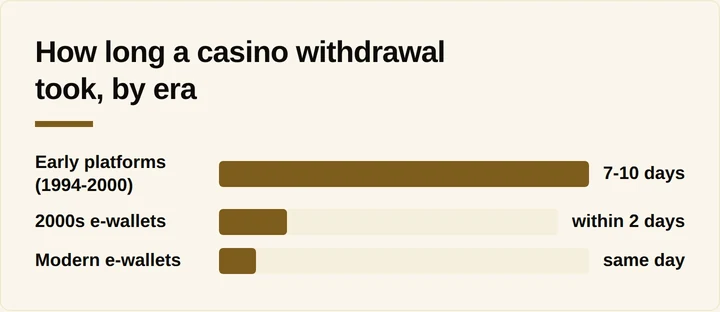
- Processing times: 7-10 days for withdrawals
- Graphics quality: basic 2D sprites and limited animations
Regulatory Development and Payment Evolution (2001-2010)
Government oversight caught up with the industry through the 2000s, unevenly and country by country. The UK set up its Gambling Commission in 2005, giving operators one of the first comprehensive licensing regimes anywhere. Malta and Gibraltar built out competing licensing frameworks around the same period, both aimed at giving European-facing operators an audited home base and formal regulatory oversight.
Canada took a different, slower path.
British Columbia launched PlayNow.ca in 2004, becoming the first legal online casino in North America, run directly by the provincial lottery corporation as a government monopoly. Quebec followed with Espacejeux, extending the same provincial-monopoly model with government operation as the sole provider. One government-run site per province defined Canadian online gambling for close to two decades, and it’s a big part of why Ontario’s later shift to licensed private operators felt like such a sharp break from precedent when it finally arrived.
Payment processing moved fast in this decade too. Neteller and Skrill became the standard e-wallets for online gambling, cutting withdrawal times dramatically. E-wallet withdrawals cleared within two days. Bank transfers still required 3-5 business days to process. For players used to waiting considerably longer for a wire transfer, this speed felt revolutionary.
Key Regulatory Milestones:
| Year | Development | Impact |
| 2004 | BC launches PlayNow.ca | First legal Canadian online casino |
| 2005 | UK Gambling Commission established | Comprehensive regulatory framework |
| 2006 | Malta gaming authority licenses | Major European licensing hub |
| 2010 | Quebec launches Espacejeux | Second provincial platform |
Mobile Revolution and Live Dealer Innovation (2011-2018)
Smartphones fundamentally reshaped online casinos. The iPhone’s launch in 2007 and the Android phones that followed put a casino lobby into every player’s pocket. Operators spent the next several years reacting to the mobile transition and adapting their platforms.
Most early mobile casino sites displayed squeezed-down versions of desktop pages. HTML5 technology replaced Flash and enabled developers to build games that rendered identically across mobile browsers and desktop layouts without plugins. Dedicated apps followed, and mobile devices were generating roughly 40% of total online casino revenue industry-wide. Touch-optimized interfaces and gesture controls arrived years later, creating parity between phone and desktop experiences.
Live dealer tables solved a different problem. Players felt that an automated random-number generator, however fair, didn’t capture the experience of a real casino. Evolution Gaming built out the first large commercial live-streaming platforms, filming real dealers from studios and streaming the action to players’ screens. Broadband speeds weren’t consistently good enough for smooth video until the mid-2010s, at which point live dealer options stopped being a novelty and became a standard menu item. By the end of the decade, live dealer games were generating an estimated 15 to 20% of online casino revenue. The appeal centers on the social experience of watching a real person deal cards, something many players from the physical casino era say they value online. Card mechanics rarely explain that appeal; the human element does.
The first live-dealer blackjack table I played through a mobile hotspot, years after that broadband threshold, didn’t stutter once. It’s a small thing, but it says a lot about how far connection speeds and streaming infrastructure moved since the dial-up era described above.
Mobile Gaming Evolution:
- First dedicated casino apps launch and proliferate
- HTML5 technology enables cross-platform compatibility
- Mobile-first design becomes industry standard
- Mobile devices generate substantial revenue share
- Touch-optimized interfaces and gesture controls mature
Canadian Market Maturation (2015 to Present)
Ontario spent years talking about opening its market to private operators before it actually happened. Discussions about liberalizing gambling regulation started several years before the market launched, and international operators reportedly began quietly preparing for a Canadian entry well before any legislation passed, betting that a shift was coming even without a firm date.
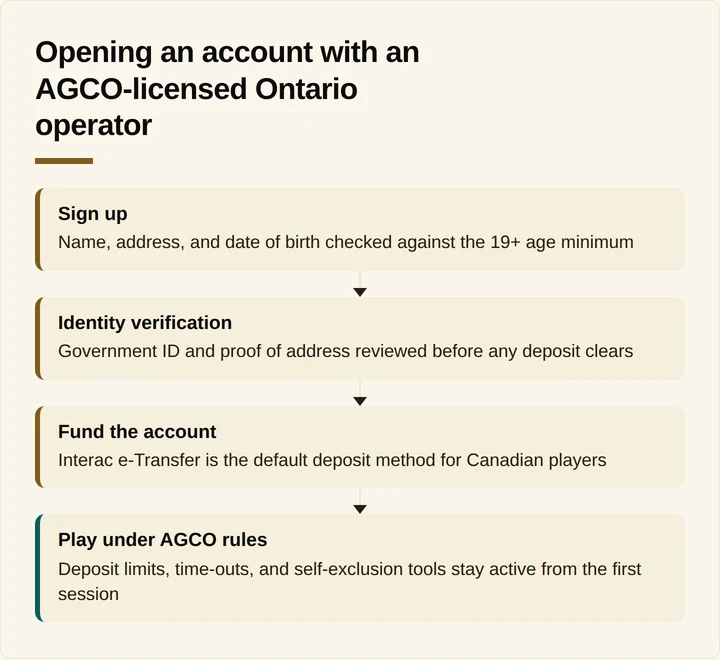
Interac e-Transfer became the default way Canadians moved money to and from casino accounts during this stretch, gradually pushing bank wires and cheques to the margins.
Ontario’s regulated market launched that year, run jointly by the Alcohol and Gaming Commission of Ontario (AGCO) and iGaming Ontario. It was the first Canadian jurisdiction to license private operators directly, breaking from Canada’s precedent of government-run monopolies and opening the market to multiple licensed brands. Fifteen operators went live on the opening day. That number grew past 50 as more brands cleared AGCO’s licensing process over the following months. I opened accounts with several newly licensed operators the same week the market launched, mostly out of curiosity about how different an AGCO-licensed site would feel from the old grey-market alternative. The identity verification process demanded more documentation and scrutiny.
Ontario Market Performance at Launch
| Metric | 2022 Launch-Year Value | Context |
| Revenue | $1.45 billion | Exceeded early projections |
| Licensed Operators | 50+ (by month 18) | Up from 15 at launch |
| Player Channelization | 65% regulated / 35% offshore | Launch-year split |
| Mobile Usage | 70% | Primary access method |
Ontario is now well into its period of regulated play, and by most public accounts the market has kept growing past that opening snapshot. More operators hold licenses today than at launch, and channelization toward the regulated market has climbed. This metric tracks the share of Ontario bettors on licensed regulated platforms. More recognizable brands built out a Canadian presence, driving this growth. Ontario doesn’t republish every metric on a fixed public schedule, so the table above represents the market’s opening snapshot from that launch window.
The regulated market pushed operators into aggressive customer acquisition early on, and that hasn’t really let up. Welcome bonuses matching 100% to 200% of a player’s first deposit became the standard opening offer across licensed Ontario sites, often paired with a large free-spins package. Bonuses at that scale come with wagering requirements attached. Ontario’s advertising rules require responsible-gambling messaging alongside every promotion for exactly that reason. Ontario’s legal gambling age is 19, and every licensed operator must offer deposit limits, time-outs, and access to the province’s self-exclusion program. Anyone whose betting habits spiral can call ConnexOntario for free, confidential support around the clock.
Current Technology and Future Directions
Modern online casinos run on infrastructure built to handle thousands of concurrent players simultaneously, eliminating the lag that characterized early dial-up platforms. Game libraries topping 3,000 titles, spanning slots, table games, live dealer studios, and specialty formats like crash games and bingo, are close to a baseline expectation for any operator trying to compete for Ontario players today.
AI is embedded throughout the platform in ways players may not recognize.
Personalized game recommendations, automated responsible-gambling monitoring that flags unusual deposit or session patterns, and first-line customer service chatbots all run on similar machine-learning models, mostly working quietly in the background. Payment options have kept expanding. Traditional cards, e-wallets, prepaid vouchers, cryptocurrency, and instant bank transfers now sit side by side on most deposit pages. Most methods process instantly, and e-wallet withdrawals typically clear the same day. Waiting on a withdrawal from a licensed Ontario e-wallet account took under a day when I tested one recently, a stark improvement over the week-long waits for wire transfers in earlier decades.
Emerging Technologies:
- Virtual reality casino environments replicating land-based atmospheres
- Blockchain integration for provably fair gaming verification
- AI-powered game hosts reducing operational costs
- Smart contracts automating bonus terms enforcement
- Predictive analytics for enhanced personalization
Virtual reality casino environments remain a niche product with limited adoption today, and that’s unlikely to change quickly. Headset costs have come down and a handful of operators run VR poker rooms or blackjack tables experimentally. Adoption remains limited, with most licensed Ontario sites not offering VR options today. Whether that shifts meaningfully over the next few years probably depends more on headset prices and content libraries than on anything an individual casino controls. Blockchain-based provably-fair tools remain available at a growing number of crypto-friendly operators yet have minimal presence on mainstream Canadian-facing sites.
FAQ
When did online casinos first launch?
The first online casino launched following Antigua and Barbuda’s Free Trade and Processing Act. The Gaming Club, using Microgaming software, offered a small basic game library with rudimentary graphics that were limited by slow dial-up connections.
How did mobile gaming change online casinos?
Smartphone adoption fundamentally changed casino accessibility. HTML5 technology enabled developers to build cross-platform games without plugins. Within years, mobile devices were generating a substantial percentage of online casino revenue. Touch-optimized interfaces became standard as the mobile experience matured.
When did Canada open its regulated online casino market?
Ontario launched its regulated market, becoming the first Canadian province to license private operators directly. The market generated substantial revenue in its opening year. More than 50 operators were licensed within the first year and beyond.
Is online gambling legal in Ontario right now?
Yes. Ontario’s regulated market has run continuously since its launch, overseen by the AGCO and iGaming Ontario, with dozens of licensed private operators active in the province. Playing on a properly licensed operator is legal for anyone 19 or older. Unlicensed offshore sites sit in a legal grey area that Ontario’s framework was built specifically to move players away from.
How is a licensed Ontario casino different from an unlicensed offshore site?
A licensed Ontario operator answers to the AGCO, offers Canadian-dollar accounts, supports Interac e-Transfer directly, and is required to provide deposit limits, self-exclusion tools, and responsible-gambling resources. Offshore sites outside that framework aren’t subject to the same audits or player-protection requirements, even when they still accept Canadian players.
Did provincial lottery sites like PlayNow.ca and Espacejeux disappear when Ontario opened its market?
No. Ontario’s licensing model only applies within Ontario; British Columbia’s PlayNow.ca and Quebec’s Espacejeux still operate as their own province’s government-run platform, and each province continues to set its own online gambling rules.
What technological advances define modern online casinos today?
Current platforms feature large game libraries, live dealer streaming, mobile-first design, and AI-assisted personalization. Responsible-gambling monitoring tools are integrated throughout. Payment processing supports cards, e-wallets, and cryptocurrency, with most deposits instant and most withdrawals clearing quickly.
What’s next for online casino technology?
Virtual reality and blockchain-based provably-fair tools are the two most-watched developments, but neither has reached mainstream adoption on Canadian-facing sites today. Broader adoption will depend on falling headset prices and growing content libraries, which individual operators cannot control alone.